
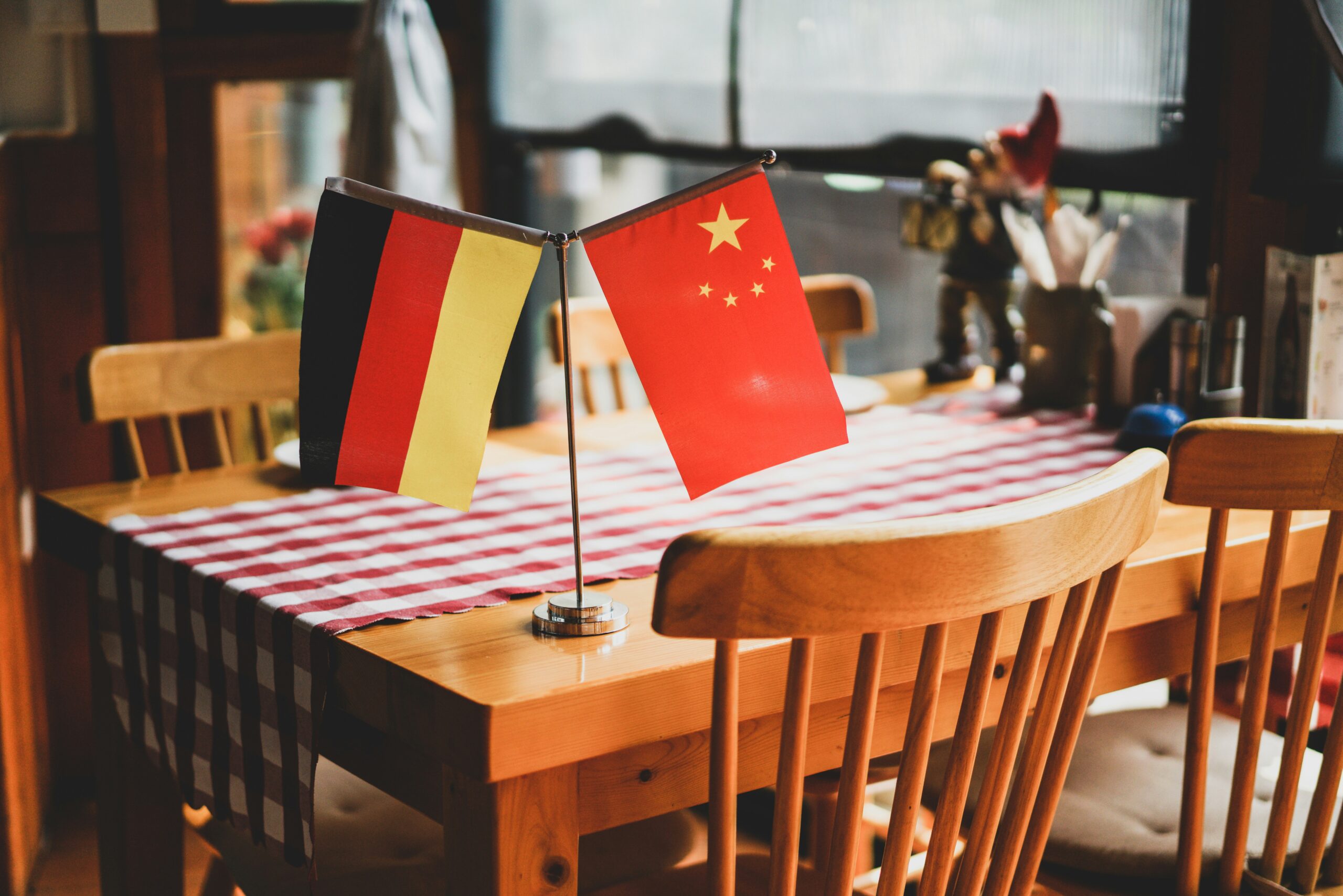

Germany is moving from abstract warnings about “de-risking” from China to hard policy choices, as a fresh series of trade shocks exposes just how vulnerable Europe’s largest economy remains to Beijing’s leverage over critical materials and supply chains.
On Thursday, the Bundestag appointed a high-level expert commission to rethink Berlin’s trade policy with China. Unlike the broad, largely aspirational China strategy published in 2023, this new body has a sharper mandate: deliver concrete recommendations that can be turned into law. Its members — drawn from industry groups, unions and think tanks — are expected to focus on three pressure points that now define Germany’s China problem: energy, raw material imports, and Chinese investment in critical infrastructure.
The timing is not accidental. Over the past year, Berlin has found itself squeezed between two assertive superpowers: a White House under Donald Trump that has rattled global trade with aggressive tariffs, and Beijing, which has answered with its own curbs, including restrictions on exports of key rare earths. For Germany’s manufacturing-heavy economy, that combination has felt less like a distant geopolitical chess match and more like a stress test.
“China can and will turn off the tap in critical areas; we remain far too vulnerable — so the pressure to act is now much higher,” said Juergen Matthes, head of international economic policy at the German Economic Institute (IW), in comments that capture the shift from theory to urgency.
De-risking on Paper, Dependence in Practice
Back in 2023, Germany’s first China strategy under the previous government popularised the term “de-risking” — framing Beijing as partner, competitor and systemic rival — and urged companies to diversify away from a single market and supplier base. But the document stopped short of binding targets or enforcement tools.
Two years on, the data suggest that not much has changed. An IW study of more than 14,000 product groups found that around 200 categories still depend on China for at least half of imports, a relatively small slice of overall trade but an outsized risk in critical segments such as advanced materials and components. In several areas, including rare earths, Germany still sources roughly 80% of its imports from China.
“Since the 2023 China strategy, I see no real progress on de-risking in my empirical research — what should have set off alarm bells just didn’t,” Matthes said.
That gap between strategy and reality is what the new commission is meant to address. Rather than simply advising caution, it is expected to assess where China has real “levers” to exert political pressure — from minerals and battery inputs to telecoms and port terminals — and propose measures ranging from diversification incentives and stockpiling to tighter screening of Chinese investments.
Trade Squeeze and Political Bandwidth
Chancellor Friedrich Merz came into office in May promising to restart growth after two years of economic contraction. But as Germany tries to escape stagnation, it is doing so in a radically changed external environment: U.S. tariffs that disrupt long-standing trade flows, a more interventionist China, and rising expectations from allies that Berlin shoulder more of Europe’s economic and security burden.
“The elephant in the room is the dependency,” says Jens Eisenschmidt, chief Europe economist at Morgan Stanley. “Decoupling is just impossible.” The reality, he argues, is that Germany has to find a middle path — reducing single-point vulnerabilities without tearing up the economic model that made it an export powerhouse.
So far, government bandwidth has constrained that pivot. Merz has spent much of his early tenure focused on domestic reforms, managing coalition politics, and responding to crises from Ukraine to the Middle East. Early on, his foreign-policy priority was building a workable relationship with the Trump administration and stabilising Europe’s security architecture, rather than redesigning China policy from scratch.
The latest round of trade tension has forced a reprioritisation. Rare earths curbs from Beijing made the dependency problem impossible to ignore. Then a separate row between the Netherlands and China over Chinese-owned chipmaker Nexperia triggered supply disruptions that rippled through German auto and electronics production — highlighting how exposed German industry remains to chokepoints it does not control.
From Vulnerability Mapping to Policy Choices
Finance Minister Lars Klingbeil will be the first senior figure from the new coalition to visit China, travelling to Beijing in the coming days to present the European Union’s concerns on tariffs, market access and critical inputs. Foreign Minister Johann Wadephul, by contrast, postponed his planned October trip after Beijing confirmed only one of the political meetings Berlin had requested — a small but telling sign of how strained the relationship has become.
“Risk management will play a larger role in the future China strategy,” said Juergen Hardt, foreign policy spokesperson for the ruling conservatives. “The question is: where are the levers China could use to exert political pressure, and how do we avoid them?”
For German companies, the answers will be uncomfortable. Reducing reliance on Chinese inputs and markets often means higher costs, at least in the short term, and the need to build new supplier networks in regions from Southeast Asia to Latin America. For the state, it could require a mix of carrots and sticks: export-credit guarantees tied to diversification, targeted subsidies for strategic projects, and tighter oversight of infrastructure deals.
What is clear is that the era of relying on political goodwill and market logic alone is over. A decade ago, German boardrooms largely saw China as a growth engine. Today, the conversation is about risk concentration, resilience — and how quickly what looks like a commercial relationship can become a geopolitical liability.
As Merz tries to put Europe’s largest economy back on a growth track, Germany’s China rethink is no longer a niche debate for foreign-policy circles. It is becoming a core question for Germany’s industrial strategy and for investors trying to price the new realities of global trade.


