
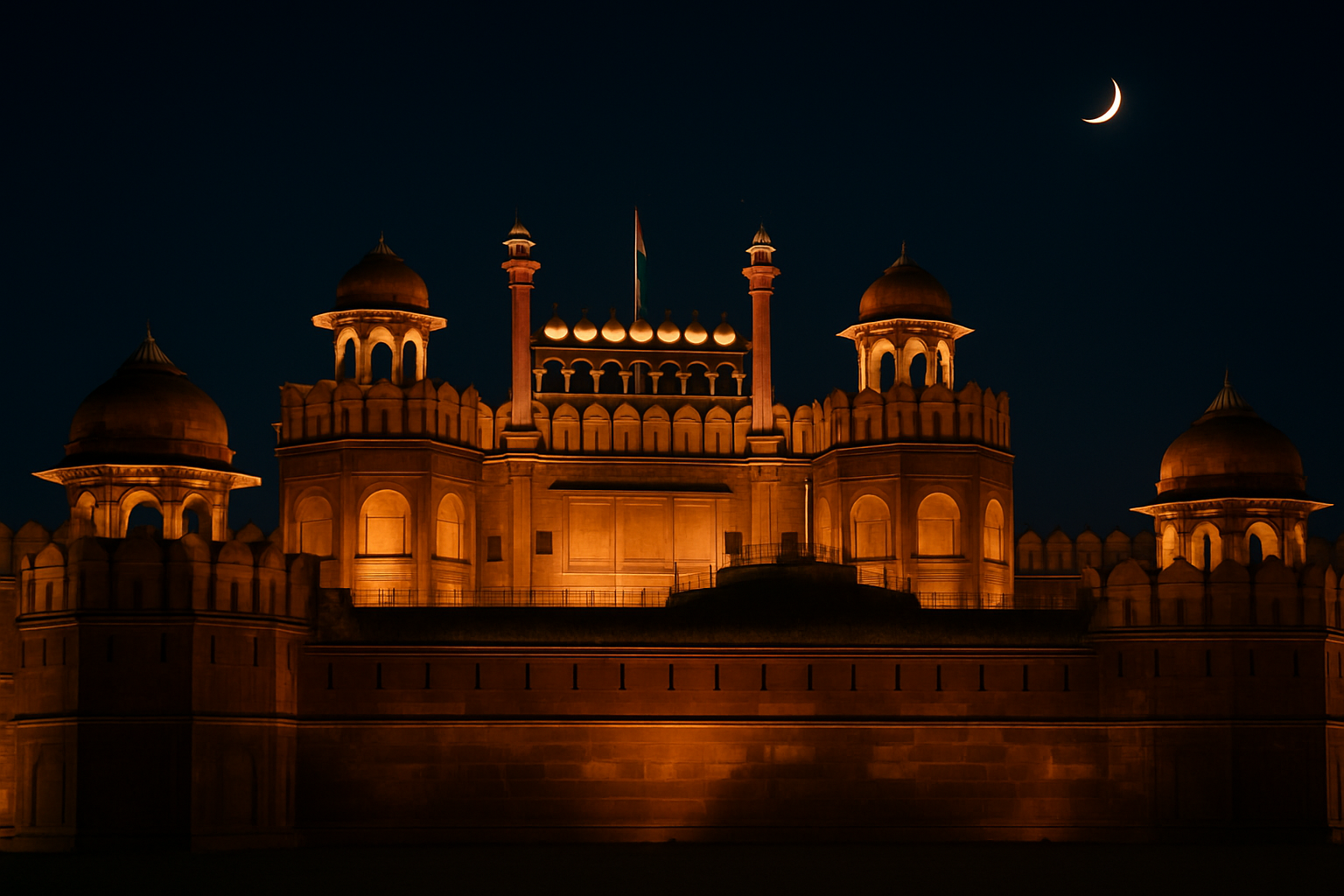

India’s capital was still reeling on Wednesday as the government confirmed that the car explosion near Delhi’s Red Fort was a “terror incident.” The attack, which killed eight people and injured at least twenty more, marks the city’s first major blast in over a decade — and has thrown a shadow over one of Asia’s fastest-growing economies.
Authorities say the explosion, which tore through a crowded market district on Monday evening, is being investigated under India’s strict anti-terrorism laws. Officials have yet to name any suspects, but early leads suggest a potential link to a network of arrests made days earlier in the disputed Kashmir region, where police detained seven men—including two doctors—with ties to banned militant groups.
In a late-night emergency session, Prime Minister Narendra Modi’s cabinet issued a resolution calling the attack a “heinous terror incident perpetrated by anti-national forces” and vowed swift justice. “The investigation will be pursued with the utmost urgency,” the statement read, underscoring the government’s effort to project control as Delhi’s security apparatus braces for political and economic aftershocks.
A Capital Under Tension
For a city of more than 30 million, Delhi has been relatively insulated from terrorism in recent years. The last comparable blast, in 2011, targeted the High Court and killed 15 people. This week’s explosion shattered that sense of urban stability, rattling both residents and investors in a country eager to showcase itself as a global business destination.
The Red Fort, a UNESCO World Heritage Site and symbol of Indian sovereignty, lies at the heart of the old city. Its proximity to government ministries and tourist corridors has made the blast especially alarming for both domestic and foreign observers.
“This kind of violence hits confidence beyond the immediate area,” said a South Asia security analyst based in Singapore. “Delhi is a signal city. When something happens there, it challenges the perception of India as a secure and investable democracy.”
Kashmir Connection Under Scrutiny
Just hours before the blast, police in Kashmir announced the arrest of seven men during a series of counterterrorism raids that spanned three Indian states. The suspects—among them two medical professionals—were allegedly part of a “white-collar terror ecosystem” that used professional networks and digital channels to communicate with foreign handlers based in Pakistan and elsewhere, according to police statements reviewed by Reuters.
Authorities said they recovered assault rifles, pistols, and nearly three metric tons of bomb-making material during the raids. The groups cited, Jaish-e-Mohammad and Ansar Ghazwat-ul-Hind, are both banned in India and accused of operating from Pakistan.
Investigators are now examining whether the driver of the car that exploded in Delhi may have had professional or personal links to one of the arrested doctors. Federal agencies, including the National Investigation Agency (NIA), have taken over the probe.
Pakistan’s foreign ministry declined to comment on the reports. Islamabad has repeatedly denied accusations that it supports militants in Indian-administered Kashmir, where a separatist insurgency has simmered since 1989.
Economic Ripples Beyond the Capital
While the investigation unfolds, the political fallout is already visible. India’s financial markets remained largely stable on Tuesday, but analysts warned that prolonged uncertainty or additional attacks could dampen foreign investment inflows, particularly in infrastructure and tourism sectors.
“The Modi government has built much of its global pitch on a narrative of order, security, and modernisation,” said an economist at a Mumbai-based think tank. “An incident like this—especially in Delhi—tests that promise.”
India has attracted record levels of foreign direct investment in recent years, positioning itself as a manufacturing alternative to China. Yet a resurgence of security threats, analysts say, could complicate this narrative just as multinational corporations seek political stability for long-term planning.
Delhi Responds, Kashmir on Edge
Since the explosion, security forces have carried out hundreds of raids across Jammu and Kashmir, detaining roughly 500 people for questioning. Most have been released, but the wave of arrests has stirred unease in a region where distrust between civilians and the state remains high.
Meanwhile, the atmosphere in Delhi has grown tense but defiant. Police checkpoints have multiplied, and large public gatherings are being closely monitored. Prime Minister Modi visited victims at a local hospital on Tuesday, pledging full accountability and urging citizens “not to allow terror to divide the nation.”
For India, the path forward will test both its intelligence networks and its image as an emerging power in an unstable neighborhood. The blast near the Red Fort was more than an attack on civilians—it was a symbolic strike at the core of Indian authority.
As one senior security analyst put it: “The question now isn’t whether Delhi can recover. It’s whether India can convince the world that it’s still safe to bet on its future.”


